It’s been done before and better.
—Dan John
Years ago, I acquired a full set of dumbbells and asked one of my good friends, a former bodybuilding champion, to show me how to use them properly. We did the usual drills you see in commercial gyms: seated presses, lateral raises, flyes, triceps extensions, and of course… curls. You’ve done the same. Admit it.
Then I discovered kettlebells and the power of full-body kettlebell lifts. The carryover was superior, the training simpler. I decided I could do everything better with kettlebells and gave the entire dumbbell set to one of my students.
Fast-forward.
As I explained in Part 1 of this series, once I started traveling more, I often found myself in gyms with no barbells and no kettlebells—or just a few very light kettlebells. However, almost every gym I visited, including hotel gyms, had one thing in common: a rack full of dumbbells, often including serious weights.
Now what?
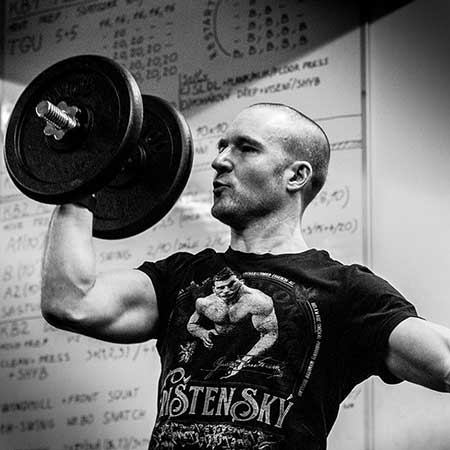
Some of our kettlebell lifts can be done with dumbbells: get-up, press, push press, jerk, bent press… Almost the same. Almost—because as I later found out, there are crucial differences if you want to lift heavy and stay injury-free.
I remember people doing biceps curls and seated presses with kettlebells, using them like dumbbells for isolation work. I made a similar mistake: trying to perform dumbbell lifts exactly like hard style kettlebell lifts.
Better—but still not right.
What about swing, clean, snatch? I tried many options commonly seen in today’s fitness world. None of them felt quite right or safe, especially with heavier weights or higher reps. For high-rep ballistics, the kettlebell clearly is the better tool.
So, the question became:
Is there a different method and approach, specifically for dumbbell quick lifts?
Yes, there is—and the differences are even more pronounced than in the grinds. The clean is quite different, and the old-school dumbbell overhead swing is an altogether different animal: not a swing, not a snatch, but a swing-snatch hybrid. It was far more popular in the old days than today’s typical high-rep dumbbell snatches—and in my opinion, it is far superior.
Rise and Fall of the Dumbbell
Bodybuilding is the worst thing that ever happened to strength training.
—Dr. Ken Leistner
I own an extensive collection of rare old-time strongman books, booklets, mail-order courses, manuals, and magazines. I dug into this archive, began extracting the long-forgotten knowledge of dumbbell lifting, and realized that the old-timers had comprehensive systems and distinct schools of dumbbell training.
With the advent of weightlifting and later powerlifting, attention shifted to barbells. Dumbbells were increasingly pushed into the role of “bodybuilding accessories” only. Not entirely, though. Lifters such as John Grimek, Doug Hepburn, Paul Anderson, and Tommy Kono kept selected dumbbell lifts in their arsenal. They considered them some of the best assistant exercises for Olympic weightlifting and powerlifting—especially the dumbbell overhead swing, single dumbbell clean and press, and double dumbbell clean and press.
Still, we have witnessed the sad decline of what used to be a respected weapon against weakness.
First, many strongmen and mail-order gurus began pushing high-rep routines with only light dumbbells—some even claiming their monster lifts and impressive physiques came purely from those half-kilo weights. Light dumbbell work has its place—as pre-hab, warm-up, connective-tissue training, etc.—but it is not the whole story.
Second, a small handful of powerful full-body dumbbell lifts slowly mutated into long laundry lists of exercises, then endless variations, and finally pure isolation work. Dumbbell lifting devolved into dumbbell exercising—precisely what you see in most fitness centers today. How about going back to the roots, identifying, and selecting the drills that deliver the most “bang for the buck”? Think S&S, ROP, AXE, and our StrongFirst curriculum in general.
Third, as weightlifting and later powerlifting took center stage, dumbbell lifts (and many classic barbell and kettlebell lifts as well) fell out of favor. Once there were no contests in those lifts, most people simply stopped training them. Only a few smart athletes kept them in their arsenal—because dumbbells helped to drive their competitive numbers up.
Deconstruction, Selection, Resurrection
If you want to learn something new, read an old book.
—Anonymous
The title of this article is a tribute to Brooks Kubik, one of the major forces behind the revival of old-school dumbbell lifting. He produced a VHS tape called “The Lost Art of Dumbbell Training,” and later the book “Dinosaur Dumbbell Training,” featuring more than 100 dumbbell drills and variations. But as he wrote in one of his articles, his primary focus in dumbbell training came down to a few selected lifts:
The two-dumbbell clean and press, one-hand dumbbell clean and press, the one-hand and two-hand dumbbell clean and push press (or jerk), the one-hand dumbbell [overhead] swing.
Following our school’s “inch wide, mile deep” approach (Dr. Mark Cheng, StrongFirst Certified Master Instructor), I started looking for an answer to the questions:
What would a StrongFirst Dumbbell Program Minimum look like?
Which 20% of the lifts should I focus on for 80% (or more) of the results—and in what order?
For the time being, I decided to skip the two-dumbbell lifts, including the old-time favorite double dumbbell clean and press, and concentrate on single dumbbell work.
When I surveyed the classics, a pattern emerged:
Eugene Sandow
- How to Lift by One Hand from the Ground to the Shoulder
- One-Handed Slow-Press from the Shoulder
- One Hand Swing-Lift from the Ground over the Head
Edward Aston
- [Clean and] The Military Press
- The “Dumbbell Swing”
Aston considered the overhead swing “one of the most fascinating of all [lifts]” and devoted a special chapter and detailed instructions to it in “Modern Weight-Lifting and How to Gain Strength.”
Thomas Inch
- The Dumbbell Swing
- The Dumbbell [Clean and] Jerk
George Hackenschmidt
- Snatch with One Hand
- One-Arm Swing of Dumbbell
- One-Arm Jerk
- One-Arm Press
As you can see, a clear theme keeps repeating: overhead swing, clean, press—exactly the drills from Goerner’s Chain discussed in the first article.
I am skipping ahead, but this is the Chain, performed with the dumbbell:
Kettlebell vs. Dumbbell: Clean, Press, Swing
On the surface, some lifts look almost identical. Let’s take the press first and save the pulls for later.
You can press a dumbbell like a kettlebell, but soon you will notice that, beyond the different grip and wrist position, several key things change:
- Rack is different
The kettlebell sits nicely in the V of the forearm. But what is the correct dumbbell rack? Front end pointing inward, forward, outward, or to the side?
- Pressing groove is different
Straight up, slightly arced, a bit out to the side? The groove will not be the same as with a kettlebell.
- Stability demands are different
The kettlebell is “locked in” on the forearm. The dumbbell wants to misbehave—the dumbbell’s weight is distributed to two sides, which can create “two teetering ends” balancing on your wrists.
A lot of neural drive is spent just stabilizing it. A lot of neural drive is spent just stabilizing it.
- Body mechanics are different
Because of the groove, your body position changes. Do you shift your hip under the dumbbell? How much do you lean? Where do you look?
- The sticking point is different
The kettlebell’s outside center of mass helps guide you into the lockout. With the dumbbell, you must create that same advantageous path.
Most lifters will initially press less with a dumbbell than with a kettlebell. Don’t worry. I studied how the strongest dumbbell pressers—Inch, Grimek, Hepburn, Anderson, and many others—actually lifted, and eventually surpassed my own one-arm press record, strictly pressing 37.5kg left and right at 68kg bodyweight.
As for the pulls:
- Back swing/pre-swing
In the dumbbell clean, the backswing (when used) is more challenging: the dumbbell tends to pull you forward. Most old-timers cleaned from the floor (a proper clean). If they used a forward pre-swing (rather than a back swing) or did repetition cleans, they often dropped the dumbbell straight down—they called it “the dive.”
- “Squinge” instead of a hinge
Dumbbell pulls often use neither a strict hinge nor a full squat, but rather what my colleague Helen Hall, StrongFirst Certified Elite Instructor, calls a “squinge.” What I first mistook for a bug turned out to be a feature—it lets you bring more leg drive into the lift. And if you add split/lunge variations of the dumbbell clean and overhead swing, your dumbbell lifting becomes serious leg training.
- Dumbbell clean
This is an excellent drill for teaching people to lift fast. I will bet bitcoins against doughnuts that if I show a complete beginner a kettlebell clean and a dumbbell clean, the dumbbell clean will look much better. There is no turning of the bell and no forearm banging. Add a press, and the student can start lifting with decent form very quickly.
Thomas Cerboneschi, StrongFirst Certified Team Leader and conditioning coach for the French wrestling team, teaches the dumbbell split clean to his young wrestlers as one of their first drills. Steve Baccari teaches the dumbbell clean and press to his boxers and MMA fighters.
- Dumbbell (overhead) swing
This lift is quite different from a kettlebell swing or snatch—somewhere between a dead swing (but pulled more upward) to an almost straight-arm snatch. As for the true dumbbell snatch, it is a valuable skill, especially as a stepping stone to the one-arm (!) barbell snatch—watch Klokov. But for high reps, commonly seen in various CrossFit workouts, the kettlebell is still the queen. For dumbbell ballistics, dumbbell low rep/heavy cleans and overhead swings rule.
Beyond the basic technique, I found many details, tips, and tricks that allowed old-time strongmen to lift safely and heavy, much heavier. Just a quick preview:
- Asymmetrical grip
Grabbing the dumbbell closer to one end can spare your grip and help you swing heavier weights overhead.
- Asymmetrical loading(!)
Intentionally offset loading for certain lifts—so-called “back hang”—can revolutionize the dumbbell overhead swing and has given lifters overnight PRs.
- Triple extension and shrug
Pure power work. Unilateral Olympic lifting for regular people. Similar and complementary to athletic drills (in case of the dumbbell pulls, same arm and leg)—built on top of the get-up.
- Use of the non-lifting hand
The “free” hand is not really free—it helps you to pull heavier weights and acts as both a gas pedal and a brake in the “squinge.”
Same, but different—yet all these “small” differences add up to a huge difference.
Forging the Missing Link
Innovation is taking two things that already exist and putting them together in a new way.
—Tom Freston
Around 2016, I set out to reforge this missing link—reading, lifting, teaching, experimenting, corresponding, and lifting again—combining StrongFirst principles with old-time strongman research. Nearly a decade later, that dumbbell quest has become a complete course I’m finally ready to share.
You will see the final result in the third and concluding article of this series, plus almost 40 minutes of free instructional video of one of the key dumbbell lifts. Here is a sneak preview:
Make sure to subscribe to our newsletter to be the first to know when it is released.