
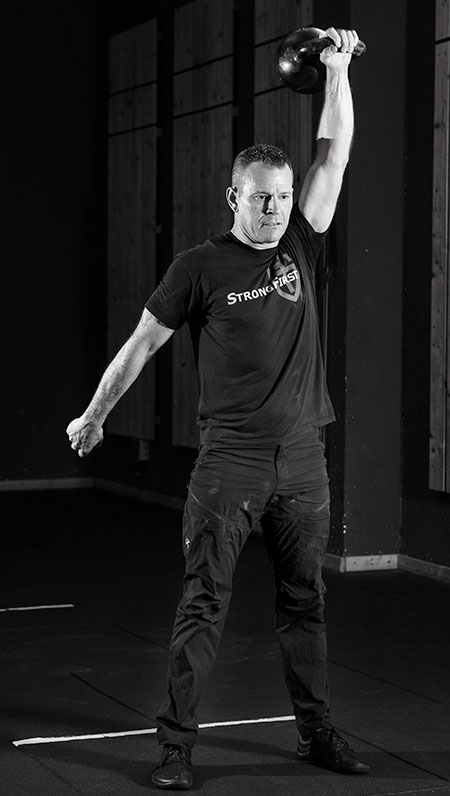
Every candidate must face the same challenge: 100 kettlebell snatches in five minutes; 50 in three minutes for seniors. The kettlebell weight is assigned according to the candidate’s body weight, age, and gender. This ensures fairness across individuals, but it does not reduce the difficulty of the task.
The test is specifically designed to measure far more than simple physical ability. It evaluates strength, power, endurance, and mental resilience under pressure. Perhaps most importantly, it demonstrates to the testing instructors that the candidate has put in the necessary work, preparation, and dedication required to even attempt such a demanding standard.
Although every aspiring SFG instructor strives to achieve the same outcome, completing the snatch test and earning the right to (re)certify, the path each person takes to arrive there can be entirely different. Some come from strength backgrounds, others from endurance; some are professional coaches and others are on personal transformation journeys.
The training methods, progressions, and strategies may differ greatly, but the destination remains the same. For this reason, the age-old saying applies perfectly: all roads lead to Rome. And in this case, all roads lead to the successful completion of the SFG snatch test.
A Plan of Action
Having understood the importance of the snatch test, the next step is to address the plan of action each candidate—or recertifying instructor—must have in place to successfully complete it. Simply showing up and attempting 100 snatches within the time limit is rarely enough. Preparation requires structure, awareness, and an honest assessment of one’s strengths and weaknesses.
There are countless rep ranges and pacing strategies that can be used to accumulate the required 100 repetitions within five minutes. But which one is best for you? Which approach should you take, and which approaches can you realistically sustain? The answer is highly individual, depending on your technical skill, conditioning, and ability to remain composed under pressure. Still, there are a few guidelines and questions that serve as a useful framework when constructing your personal plan of action:
- Technical proficiency: Do I possess the technical skill to perform 100 snatches according to SFG standards consistently, that will be counted, thereby avoiding wasted effort through “no counts”?
The Speed Metal online course is your one-stop shop for kettlebell snatch technical mastery.
- Conditioning: Am I satisfied with my level of conditioning to complete all 100 repetitions within the five-minute requirement?
- Grip strength endurance: What is the maximum number of repetitions I can safely and effectively perform with one hand before having to switch to the other?
- Switching technique: Am I proficient at executing a swing switch between hands, or do I need to set the kettlebell down between every hand change?
By answering these questions honestly, each candidate can begin to shape a plan that plays to their strengths while addressing areas that could otherwise become obstacles during the test.
Practical Solutions
There are countless rep ranges a candidate can choose from when preparing for the snatch test. The choice, however, should not be made in isolation. It must be based on the combined answers to the key questions outlined earlier, rather than relying on just one factor. Let’s revisit those questions and walk through consolidated solutions for each scenario. (In-depth recommendations will be made in the following sections.)
1. Technical proficiency
If technical proficiency is a concern, the best approach is to select a rep range that provides a buffer near the end of the test. This way, if “no counts” occur, you will have lower reps per set towards the end and therefore a bit of time to make them up without panicking and running out of time.
2. Conditioning
Lacking sufficient conditioning is a training issue that must be addressed early in the preparation process. Building a solid base of endurance through anti-glycolytic training (AGT) protocols is one of the most reliable methods for achieving this. Once the base has been established, the final “sharpening of the sword” can take place in the last few weeks of preparation. This phase can be accomplished through a simple peaking method, which will be outlined below.
3. Grip strength endurance
Developing grip strength endurance is essential to sustaining relatively high rep counts (10–20 repetitions) with a single hand. This should also be addressed well in advance—ideally 8–10 weeks out from the test. One effective method is to incorporate two sets of high-rep snatches once per week during your regular snatch training sessions. Approximately two-thirds of the way through your base AGT, perform a set of snatches to about 80% of your perceived repetition maximum (RM) with your less dominant arm. Immediately switch hands and complete the same number of repetitions with your stronger arm. Rest for three minutes and repeat the sequence. After the second rest period, continue with the final third of your planned training session.
4. Switching technique
Early in the preparation phase, it is important to decide how you will change hands during the snatch test. The safest method is to set the kettlebell down and switch hands while the bell is parked on the ground. This approach eliminates the risk of accidentally dropping the bell during a swing switch. However, it comes with a disadvantage—especially for those who struggle with conditioning—because each time the bell is set down, momentum is halted. Restarting from the ground (a “dead stop”) requires more energy and can make it difficult to maintain a steady pace throughout the test.
By contrast, changing arms with a swing switch keeps momentum flowing and allows for a smoother pace. Yet this option demands that the candidate be fully proficient in the technique and capable of executing it under pressure. A poorly timed or sloppy switch risks losing control of the kettlebell, and an accidental drop results in immediate disqualification from the test.
To minimize this risk, candidates should diligently practice the swing switch during the preparation phase. Using a less powerful hip drive combined with a controlled, low swing-to-catch motion will help reduce the chance of losing grip on the kettlebell while keeping momentum uninterrupted.
The bottom line: If in doubt, play it safe—set the kettlebell down to change hands.
Rep Ranges
All roads lead to Rome—and to passing the snatch test. Almost any combination of reps per arm that totals 100 will meet the requirement. The key is choosing the range that best matches your strengths, conditioning, and technical proficiency.
Below is a list of rep ranges that have provided countless instructors with a successful test, along with notes on who each scheme may suit best:
- 10/10 × 5: 10 reps right, 10 reps left, repeat 5 times
Balanced and straightforward; great for candidates with solid conditioning and grip endurance who prefer consistency.
- 20/20 + 15/15 + 10/10 + 5/5: descending pyramid
Ideal for those who want to take advantage of early strength while leaving shorter sets for the fatigue-heavy final minutes.
- 15/15 + 15/15 + 10/10 + 10/10: medium blocks, balanced pacing
A strong middle-ground option; suits candidates with good pacing discipline who can sustain medium-length sets without burning out.
- 5/5 × 10: frequent hand switches, steady pacing
Excellent for those with limited grip endurance or who struggle with longer one-arm sets; the frequent switches keep fatigue from building too quickly.
- 7/7 + 7/7 + 6/6 × 4: broken into smaller, manageable chunks
Useful for candidates who want psychological wins by ticking off small sets and keeping rhythm throughout the test.
- 20/20 + 20/20 + 10/10: large sets early, smaller sets to finish
Best for experienced lifters with strong grip endurance who can capitalize on early energy reserves and then coast with smaller sets at the end.
- 25/25 + 25/25: two big sets per side, minimal switching
A high-risk, high-reward approach; only suitable for advanced candidates with exceptional grip strength, conditioning, and mental resilience.
A Word of Advice
Each of these structures offers a proven pathway to completing the 100 repetitions. The decision lies in selecting the strategy that allows you to maintain consistent form, manage fatigue, and stay within the five-minute time limit.
That being said, an important reminder: there is no bonus or special reward for finishing the test in record time. The requirement is five minutes—no more, no less. For this reason, it is wise to keep one’s ego in check and avoid wasting energy unnecessarily. The test is not about racing the clock, but about demonstrating composure, technical proficiency, and the ability to endure under pressure.
One particularly effective structure is:
10/11 + 10/11 + 10/11 + 10/11 + 8/8
- If you are right-hand dominant, perform 10 reps on the left and 11 reps on the right.
- Repeat this sequence three times, for a total of 4 sets of 10/11.
- Finish with 8 reps left and 8 reps right.
This approach allows the candidate to set the kettlebell down briefly before each full minute during the first four minutes if necessary. Adding a single extra rep to the stronger arm each minute also builds in a buffer, leaving room to make up for any “no counts” or simply to have time to spare when fatigue sets in toward the end of the test.
Best for candidates who want a structured pace with built-in recovery opportunities, and those who value the psychological benefit of having a safety buffer toward the end.
A Final Peaking Tip
In the final weeks before the test, it is important to prepare the body—and just as critically, the nervous system—for the exact demands of the snatch test. One effective method is to conduct a two-minute “mini” snatch test once per week during the last 3-4 weeks of training.
The purpose of this drill is twofold:
1. Neurological conditioning: It accustoms the nervous system to the intensity and pace of the test without overreaching or compromising recovery.
2. Tempo and rep scheme practice: It provides the opportunity to refine your chosen rep scheme under realistic conditions, helping you discover and lock in a tempo that can be sustained for the full five minutes.
During these mini-tests, aim for 50–60 snatches in two minutes. This range allows you to build confidence, reinforce pacing, and sharpen technical consistency while avoiding excessive fatigue.
The goal of achieving 50–60 repetitions within the two-minute time frame can be accomplished in whichever way the student prefers, either by setting the bell down or by switching hands during swings. Personally, I recommend avoiding setting the bell down and instead switching hands as needed.
A simple and effective way to integrate this peaking technique into your existing training is to begin your weekly volume session with the two-minute test. After completing it, rest for three full minutes. Then, subtract the number of snatches completed during the mini-test from your planned total for the day and continue your training as scheduled. This way, the mini-test becomes part of the session rather than an added burden, ensuring steady progress while sharpening test readiness.
The snatch test is more than a physical requirement; it is a lesson in preparation, patience, and perseverance. Each candidate’s path may differ. Some build endurance through frequent hand switches, others push grip strength with longer sets, and still others sharpen technique through carefully chosen pacing strategies. Yet no matter how different those paths may look, they all lead to the same destination: completing 100 snatches in five minutes.
It is a worthy accomplishment; go for it.