
Injuries stink. Nobody likes them. Yet they are an inevitable part of life. Regardless of whether someone is mostly sedentary or highly active, injuries are bound to happen at some point. For people who are active, the biggest frustration is often not the injury itself, but the inability to do their chosen activity (or activities) at the level they would like to do them.
Injuries can sometimes be acute—where one “thing” happened and resulted in an immediate injury. I suspect everyone reading this has had that happen at one time or another, with a couple of examples being a slip-and-fall or a car accident.
Injuries can also be slower to develop, yet can be traced back to something. Common examples here are “overuse” injuries in people who do one particular motion repeatedly. Think about distance runners and their knees, or golfers and tennis players and their elbows.
A third category, one that I have been navigating, is injuries that are just a mystery. You wake up one day and something hurts or does not feel right, and you have no idea why. These injuries can be especially frustrating because they leave you feeling like you do not know what to avoid doing in the future to prevent them from happening again.
In my case, about nine months ago, I started experiencing an onset of pain and a loss of strength in my right arm, especially around the elbow and biceps areas. If I “made a muscle” with my left arm, the biceps would feel solid and strong. Yet on my right arm it would feel like mush. The muscle just would not seem to contract. To this day, I have no idea why. Nothing “happened” that I was aware of. It is still a mystery.
Long story short, through visiting numerous doctors, getting two MRIs and a CT scan, and trying many types of treatment, nothing was conclusive (talk about frustrating). That said, the imaging of my neck showed quite a few red flags. While nothing in the scans was a smoking gun for the symptoms in my arm, we decided to approach treatment with the assumption that something in the neck was the primary cause for what was going on in the arm.
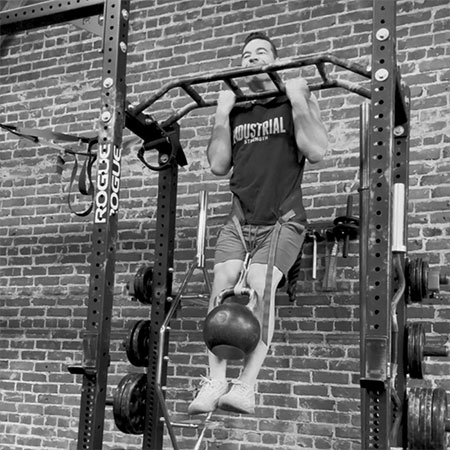
Let’s briefly circle back to the first paragraph, where I mentioned that one of the most frustrating aspects of injuries is not being able to perform your activities at the level you’d like to. For me, I love strength training, and one of my favorite exercises has always been chin-ups. In particular, I love weighted chin-ups. Prior to this injury, I was able to do a chin-up with “The Beast” (the 48kg kettlebell) pretty much any day of the week, and on an especially strong day, I’d be able to do it for a set of three repetitions. Fast forward to this injury and I had days where I couldn’t brush my teeth, turn a key, or use a fork with my right arm. Needless to say, chin-ups were off the table.
That said, I am now mostly recovered and have built back much of my strength. I wanted to share a bit about how I did this, and I hope it is helpful to you in the unfortunate circumstance that you find yourself injured at some point and need to build back.
Building Back: The Essentials
I will start by saying that it is always easier to build back to somewhere you have been before than it is to get somewhere for the first time. So, for me, getting back to a 48kg chin-up would be easier than getting there for the first time. You can probably think of some equivalent examples for yourself.
First and foremost, I listened to my doctors and stopped all activities that they suspected could make my symptoms worse and/or hinder my recovery. This required me to completely stop many of my favorite exercises and activities for about three months. No jiu jitsu. No judo. No chin-ups. No get-ups. No kettlebell swings or snatches. No barbell squats.
It was pretty miserable. But it was worth it.
After about three months, I got the green light to start trying things again.
Making a Plan with Step Loading
With respect to chin-ups, I started with no added weight. I started slowly, and over the course of a few weeks, I gradually built up to where I was able to do 10/3 (reps/sets) a couple of times per week with no pain or symptoms.
To me, step loading made a lot of sense for a few reasons. One, it is tried and true and known to work well. Two, it makes it hard to do “too much too soon” when coming back from an injury. The last thing I wanted was a setback, so choosing a plan that is intentionally a bit slow made sense.
As I re-introduced weighted chin-ups, my step-loading looked like this:
- Month 1—Weighted chin-ups 1x weekly: 5/5 at 12kg
- Month 2—Weighted chin-ups 1x weekly: 5/5 at 16kg
- Month 3—Weighted chin-ups 2x weekly:
- 5/5 on Mondays at 16kg
- 3/8 on Fridays at 24kg
In each session, I warmed up with one set of 10 body weight chin-ups before moving to the weighted sets.
Before moving on, I want to make one important note. I was careful with everything listed above to never get close to failure on any set. With every set, I had at least one (usually several) rep left “in the tank.” This approach helped make sure I was not asking too much too soon from my body as I was building back, and helped me avoid any setbacks.
The Results: All Gains, No Pain
The end of Month 3 above landed me right at my 40th birthday. I really wanted to get back to “The Beast” by then. So, the day before my birthday, I decided to give it a shot. I am happy to report that my attempt was successful, and I’m officially back to a “Beast” chin-up! I credit this to a few things, including letting the volume do the work for me. In spite of never going heavier than 24kg in training, all of that volume “greased the groove” of the weighted chin-up for me and set me up for success with the 48kg.
I’ll wrap up by sharing a few important takeaways from my journey that you can use for your own training.
First of all, if you are in the recovery process from an injury, listen to your doctors. I certainly was not thrilled about taking three months almost entirely off, but I took their advice and was the better for it.
Second of all, your body remembers where you have been, so there is no need to rush getting back. Even if you “could” do it today, that does not necessarily mean that it is a good idea or in your best interest. Build up slowly. Step loading is a fantastic tool to help you build back, and I hope that is one of the big takeaways you get from reading this. Used thoughtfully, step loading’s “slow by design” approach helps your tissues re-acclimate to training without overdoing it. I had success sticking with a particular load for a month before increasing it. The stronger you get, the longer you may need to stick with a particular load before advancing.
Third, let the volume do the work. Pushing sets too heavy, too close to failure, or a combination thereof can be the kiss of death even when healthy, let alone when building back. Emphasize weights that are moderately challenging yet allow precision with your technique, and keep your mind laser-focused on your form as you are training.