Real strength is all-round strength.
—George Hackenschmidt, The Way to Live, 1908
Around 1909, Alan Calvert’s Milo Barbell Company rolled out a universal weapon against weakness—the large-size Milo Triplex Combination Bell. One system, many options: barbell, dumbbell, and a pair of kettlebells from the same kit.
One set. No excuses. No missing links.
The ad called the set “The Royal Road to Strength.” A century later, the road has not changed: Pick it up. Get strong.
“Practice everything,” writes Arthur Saxon in The Development of Physical Power. He gives a list of various tools and lifts and concludes:
A method of practice such as the above would not only bring into play every hand and strap of muscle you possess, but also give you a far better knowledge of all-round weight-lifting, than you could possibly obtain if you practiced three or four lifts only to the exclusion of all others.
Sandow, Cyr, Apollon, Saxon, Hackenschmidt, Inch, Maxick, Pullum, Aston, Goerner, Klein, Grimek, Anderson, Hepburn, and many, many others—virtually all famous old-time strongmen—trained with all three kinds of “bells”: dumbbells, barbells, and kettlebells.
Enter the Dumbbell!
We didn’t set out to build a product. We set out to solve a problem.
—Naval
The new StrongFirst online course reforges the missing link—the dumbbell.
We plug the hard style operating system into one of history’s oldest, most battle-tested tools. No isolation fluff—just full-body, heavy, honest dumbbell lifting: ballistics and grinds, pulls and presses.
Enter the Dumbbell!—like all principle-based StrongFirst training—is “an inch wide and a mile deep”: a dumbbell program minimum with maximum return.
Doing Is Believing: Dumbbell Clean
Enough talk. Time to lift some heavy bells.
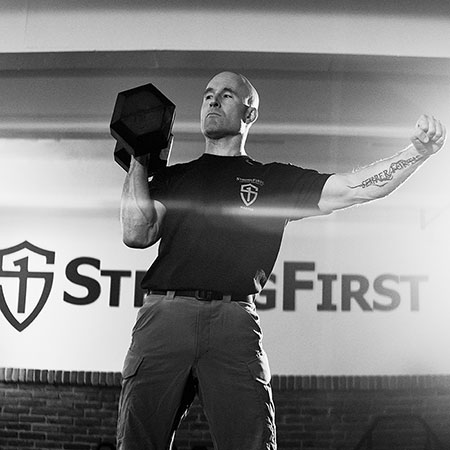
“How to Lift by One Hand from the Ground to the Shoulder” is Sandow’s first lesson in his “Heavy-Weight Exercises.” In hard style kettlebell training, we usually start with the swing—although there are good reasons to start with the clean, because, unlike the swing, we can pause at the top.
Because the old-school dumbbell swing ends in an overhead position—not out in front of the lifter—we want to make sure that you own the overhead position first. To press the dumbbell overhead, we must master the clean. To master the clean, we must first master the correct rack.
Virtually all old-school dumbbell lifts finish overhead. You must have the mobility and stability to fix the bell overhead in ballistic drills. The way to acquire it is simple: rack up a lot of clean and presses.
The dumbbell clean and press is easier to learn and perform than the kettlebell clean and press; almost anyone can do it “good enough” from the start. There are, of course, many important details—crucial not only for performance, but also for health.
The one-arm dumbbell clean is much easier to learn than the kettlebell clean—no forearm banging. Even if you skip all the nuances we teach, you will still be doing reasonably well.
We start with the clean and press because you need to get used to a solid rack and a locked-out overhead position. Once you own the clean and press, you can move on to the overhead swing and the other overhead lifts. The clean is also easier to learn than either the dumbbell swing or dumbbell snatch.
Please check out a full dumbbell clean lesson from our new online course, Enter the Dumbbell!, here:
Following Links of the Dumbbell Chain: Press and Overhead Swing
The key to happiness in life is putting heavy weight overhead.
—Jon Engum, StrongFirst Certified Master Instructor
The next lesson is, of course, the one-arm dumbbell press.
A frequently asked question: What muscles does the dumbbell clean & press train? “Canadian Hercules” Doug Hepburn suggests the following experiment in his article “Dumbbell Training Builds Lifting Power”:
…load up a heavy dumbbell to a poundage you can just about squeeze seven reps out of in fairly strict military pressing style. With each hand, run through six sets of these seven reps, finishing the six sets, even though you are unable to make seven reps! Then next day, just see how stiff you are, and not only in the triceps, biceps and deltoids, but in the forearms, trapezius, oblique muscles, hips, upper thighs and lumbar region. Dumbbell lifting supplies an almost complete schedule in itself, for every major muscle group. To heighten the effect on the upper back and shoulder girdle, lower back and thighs, clean the dumbbell for every press.
“If all you did was clean and press, you could be awesome,” says Dan John.
Onto the dumbbell overhead swing: A frequently asked question in the StrongFirst community is: “What if I could choose just one lift?”
Some old-timer testimonials—Snelbaker, Calvert, Grimek—make a strong case for the dumbbell overhead swing:
…if there were just one exercise which could be performed with a dumbbell, and it were the one hand swing in its various forms, that single dumbbell training should be made a part of the training of any man who is ambitious physically.
…
The men who hold the records in the swing… are beautifully made. Their proportions are admirable, and they are of surpassing symmetry. Since the “quick lifts” require bodily strength it means that to succeed at these lifts you must have a body which is developed from head to heel.
…
There is no doubt that it will keep your muscles, especially your back, strong and flexible and, whether you are bent on breaking records or simply trying to keep fit, either of the swing exercises will benefit you.
The dumbbell overhead swing has become not only my favorite dumbbell lift, but one of my favorite lifts, period. Just like the clean, Enter the Dumbbell! features various forms of the overhead swing—muscle, power, and split. Unilateral, low-rep power training. Dumbbell weightlifting.
Dumbbell Lifting Programs
Of what use can it be for a chain to have certain tremendously strong links if others are fragile?
—Danish physical culturist Jørgen Peter Müller
Enter the Dumbbell! connects all the links of the dumbbell Chain and presents seven different ways to plug them into your current strength training:
- The Chain—the original session that started it all
- Roll the Clock—session-duration variability
- Cut the Chain—weight variability
- Change the Links—lift variability
- Duplex—kettlebell and dumbbell Chain
- Triplex—an all-round strength program combining kettlebells, barbells, and dumbbells
- Linking the Chain—the main structured, ETK-like progressive program
Regarding Triplex, let’s return to “Goerner the Mighty” from the previous installments. His biographer outlines a simple blueprint for all-around weightlifting that includes all three tools:
Each training session of Hermann’s contained a mixed programme of kettlebell, dumbbell and barbell lifting. Sometimes a workout would also include supporting feats. For instance, when Hermann trained three times a week, he might in the first training session give preference to kettlebell exercises, but he would also include barbell and dumbbell lifts too. The second session might see the emphasis placed on dumbbell training with not so much on kettlebell and barbell work, and the third workout would have the emphasis on barbell work just with a little kettlebell and dumbbell work included in the session.
Triplex, the true Royal Road to Strength, gives you the exact protocol for doing the same: an all-round system with clear priorities and built-in variety.
For those who enjoy a structured, progressive plan, Enter the Dumbbell! also includes the main ETK-style program, Linking the Chain.
Of course, you can plug many existing StrongFirst protocols straight into dumbbells, especially for the clean & press. Save the high-rep ballistics for kettlebells—but you can still use the clean and overhead swing for various Strong Endurance-style protocols. The Chain is, in essence, original strength aerobics—Strength Aerobics with vintage roots.
Below is the full content of the course.
Enter the Dumbbell!: Old-School Lifting for Modern Strength
Module 1: Introduction (13:50)
Set your compass: learn the origin story, meet the lifts of choice, learn when to pick kettlebells vs. dumbbells, and how they differ. Get clear equipment guidance and ignite the all-around weightlifting ethos that frames the course.
Module 2: Light Dumbbell Mobility Sequence (11:08)
A simple set for beginner’s training, a morning recharge, warm-up/move-prep, joint health, or your variety training days.
Module 3: Enter the Heavy Dumbbell (14:19)
Before you start, get heavy dumbbell-ready—dial in the setup and setdown that match your build for safe, heavy, long-term lifting.
Module 4: One-Arm Dumbbell Clean (36:24)
Explosive power at a low skill toll. Builds an iron rack and braced trunk that carry over to every press and overhead ballistic. Forearm-friendly and old-school approved—the express lane to being usefully strong.
Module 5: One-Arm Dumbbell Press (28:12)
Honest, whole-body strength. Minimal gear, maximal return—“if all you did was clean and press, you’d be strong.”
Module 6: One-Arm Dumbbell Overhead Swing (29:30)
Timeless power for the whole body: speed, coordination, and explosiveness—plus serious grip and back—the “forgotten lift” done hard style.
Module 7: Combination Lifts (13:22)
Overhead Swing & Continuous Press, Clean & Press—and, finally, “Linking the Chain!”
Module 8: FAQ (24:50)
Everything You Always Wanted to Know About Dumbbell Lifting* (*But Were Afraid to Ask): when to choose kettlebells, barbells, or dumbbells; extra safety protocols, exact gear recommendations; simple programming templates; dumbbells and leg training; all-round weightlifting programming, and more.
Module 9: Outro (2:09)
You’ve got the tools: light dumbbells to armor the joints; heavy dumbbells for power and strength. The rest is up to you—make sure there are no weak links in the Chain!
Module 11: Bonus—Dumbbell Goblet Squat (9:18)
We knew you’d ask about dumbbells and squats—so here it is: learn the goblet rack for instant torso bracing, dial in your stance, and groove the squat proper for mobility and honest strength.
Enter the Dumbbell! Standards and Challenges
It’s supposed to be hard. If it wasn’t hard, everyone would do it. The hard is what makes it great.
—A League of Their Own, 1992
Henry Higgins writes in his excellent Dumbbell Strength and Muscle Course (1915):
75 lb. [~35 kg] bell is regarded in all gymnasiums as too heavy for anyone but a fairly strong man. In fact, men who try the physical tests in civil service examinations for the fire and police departments in most cities are well satisfied when they find that they are able to push up a 75 lb. bell. Men who succeed in doing this feat are marked 100% efficient.
Siegmund Klein had higher standards:
If an athlete could properly perform a one arm military with 90 lbs. he was considered strong regardless of what he could do on other lifts… If an athlete can do one-half of his body weight he has a fairly good One Arm Military Press. If he can do two-thirds of his body weight he can be considered exceptionally strong, and very few athletes have succeeded in doing this.
As for the overhead swing, old-timers were a different breed. A bodyweight one-arm overhead swing was considered a worthy goal.
We have forged new standards for you—the Iron and Steel Chain (inspired by Simple & Sinister and our SFG II curriculum), combining overhead swing, press, clean, and a second press—for both ladies and gents.
Whether you use dumbbells when traveling, as a specialized variety, as a standalone program, or as another “weapon against weakness” to build all-around strength, you will love it.
Lift kettlebells, barbells, and dumbbells. Practice your bodyweight skills. Become an all-round strong athlete loyal not to a tool, but to strength.