
The impediment to action advances action.
What stands in the way becomes the way.
—Marcus Aurelius
At the turn of the 21st century, Dr. Randall Strossen, American strength and physical culture advocate and publisher, observed that “it is easier to find honest arm measurements than a kettlebell.”
Not anymore. Twenty-five years later, thanks to Pavel and the modern kettlebell revolution he started, kettlebells are everywhere.
Almost everywhere.
As I found out during my frequent travels, there are still plenty of places where kettlebells are rare, poorly designed, too light—or missing altogether.
As for those “honest arm measurements,” that is a topic for another time. This three-part article series will instead examine my experience lifting “on the road”: the roadblocks, the detours, and the solutions.
On-the-Road Strength, No Excuses
Do what you can, with what you have, where you are.
—Theodore Roosevelt
Whenever possible, I want to stay in shape on the road. If I travel for more than a weekend, I start hunting for a nearby gym where I can get solid lifting sessions.
Because I travel frequently, I favor programs such as Simple & Sinister—3 lifts, step periodization, nothing complicated. If I miss a session, no problem—I can quickly return to my main training weights.
Suppose I find a gym with proper kettlebells—perfect. Problem solved. Or better yet: no problem in the first place.
But in many gyms I have visited, the “kettlebell corner” was a sad sight: a couple of very light bells or some no-name company’s weirdly shaped “kettle-balls” made by people who clearly have no clue about kettlebell lifting.
Now what?
One obvious option: switch to our SFB bodyweight arsenal. The Naked Warrior is an excellent choice for kettlebell lifters on the road. Sometimes I used the “Grease the Groove” with one-arm pushups and pistols; other times, I switched to a more conventional ladder approach, e.g., 1-2-3 ladders.
As long as I maintained movement quality—doing, for example, just “shoe get-ups”—and kept up my Second Wind breathing drills, I returned to my regular heavy kettlebells very quickly… and very often stronger than before.
But what if I still wanted to keep my iron skills sharp?
If the gym had barbells, the problem would be solved again. Even a rack was optional: I could run my favorite “no-rack” Power to the People! program—deadlift and bridge floor press (or side press). Add Zercher squats and you get an excellent old-school “no rack, no problem” powerlifting routine.
But some of the gyms I visited did not even have barbells. Just a couple of machines, a weird bike that goes nowhere, a treadmill (with TV!), and a dumbbell rack with a pretty good selection of weights.
…Wait. A dumbbell rack? How about doing our commonly used SFG drills with dumbbells?
Many old-time strongmen trained with kettlebells, barbells, and dumbbells—“father of heavy athletics” von Krajewski and his students; Lebedev, Poddubny, “Russian Lion” Hackenschmidt; Sandow, Saxon, Inch, Klein, Goerner, and many others.
The last name on that list, “Goerner the Mighty”, was a German strongman celebrated for extraordinary all-around strength, who, according to his biographer, performed “approximately 1,400 different feats of strength of all varieties.” With that being said, his training program was principle-based—intuitive, but not complicated. Most of the time, he started with a simple template—a kettlebell and dumbbell Chain.
Kettlebell Chain
…He would usually start by working out through what in Germany we call “Die Kette”—The Chain—but this is no ordinary chain…Down one side 44 of the gymnasium is a row of [paired off] kettleweights… The kettleweights were placed in a row on the floor of the gymnasium, and working “Die Kette” (or The Chain) meant that Herman would start out by taking the first kettleweight in the right hand and swinging it to arm’s length overhead. After swinging it, the weight would be lowered to the shoulder and then pressed up again and from there to the “hang” and then curled to the shoulder, then pressed overhead again and finally lowered again and replaced on the floor. He would then repeat it with the next kettleweight, using this time the left hand. The whole length of The Chain would be worked in this manner.
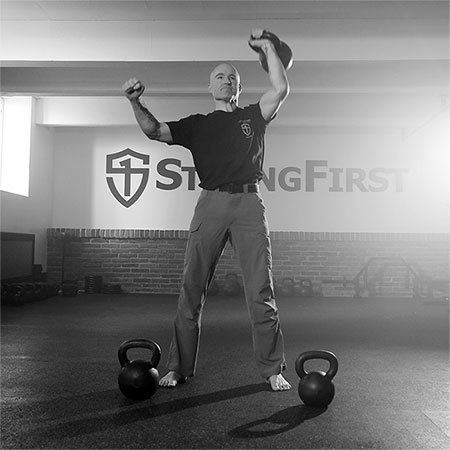
Terminology for the various lifts has changed over time, but if we adapt Goerner’s Weight Chain to our SFG standard, you would be performing kettlebell snatch, press, clean, press: Vintage Strength Aerobics.
Goerner performed it as the so-called Weight Chain, or as we say, Weight Ladder: the reps stay the same while the weight goes up, then sharply down and up again. Pavel writes in his first kettlebell book:
Constant loading and unloading is easier on your head and spurs greater gains. You can think of the ladder as a miniature power cycle compressed from weeks to minutes.
Goerner had access to nineteen pairs of kettlebells, ranging from 13 to 52.5 kilos, and did the Chain for 40 minutes. As Pavel notes that “you can do just as well with three sets of kettlebells,” and you can do less than 40 minutes, especially if you have other items on the menu and don’t make your living by breaking records.
Over the years, I have devised many variations on Goerner’s Weight Chain: “Roll the Clock” (session duration variability—20, 35, 45 minutes), “Cut the Chain” (weight variability), “Change the Links” (lift variability), and some others. We will share them all very soon in one of our upcoming projects. For now, here is the first variation—“Roll the Clock”—and how to run it.
Kettlebell Weight Chain: “Roll the Clock” (Session Duration Variability)
Use a die to determine the duration of your session. Roll again if you get the same time frame as in your last session.
- 1, 2 = 20 minutes
- 3, 4, 5 = 35 minutes
- 6 = 45 minutes
(Special thanks to Fabio Zonin, StrongFirst Certified Master Instructor, for adjusting the time to ensure consistency with our Delta 20 principle.)
- Work up the kettlebell rack.
- Start with your left arm: snatch, press, clean, press.
- Repeat the sequence with your right arm: snatch, press, clean, press.
- Move on to a heavier kettlebell and repeat.
- Once you reach the weight you can still lift with proper form, without struggle, at about 70–80% effort, restart the Chain with the lightest kettlebell you began with.
Keep the rest periods short—just as Goerner did.
Dumbbell Chain?
Simple… or so it seemed before I actually tried it.
Whatever is worth doing at all, is worth doing well.
—Philip Dormer Stanhope, 4th Earl of Chesterfield
Goerner was certainly very fond of kettlebell lifting:
It would be fair to say that kettleweight training played a very large part in Goerner’s workouts…. At the lifting of kettleweights, Hermann was certainly the world’s best exponent.
But:
Dumbbells also took up a considerable amount of his training time, as well as the more orthodox feats performed with the barbell.
I gave the Dumbbell Chain a try—and I failed. The dumbbell snatch felt awkward, the rack offered too many options, and my press was weak.
I experimented with performing other kettlebell lifts using dumbbells. Apart from the obvious differences—mainly the grip—some drills seemed almost identical: get-ups, cleans, presses. At least that’s what I initially thought. A “clean and press with a dumbbell” is one thing. A heavy and safe clean and press with a dumbbell is something else entirely.
Other dumbbell lifts, e.g., the dumbbell (overhead) swing, as I found out, were quite different from today’s kettlebell swing and snatch as well.
Three of my favorite old-time strongmen trained with kettlebells, barbells, and dumbbells: Saxon, Goerner, Klein. Many other famous iron game figures also loved dumbbell lifting: Aston, Maxick, Pullum, Jowett, Liederman, Hoffman, Grimek, Park, Hepburn, Anderson, Kono, and many others.
Curious to find out more, I decided to delve into my collection of old books, manuals, mail-order courses, and magazines to see if there was a real system behind heavy dumbbell lifting. To my surprise, there was. Whole schools and systems of dumbbell work emerged from the dust: “The Henry Higgins Strength and Muscle Course”, “The French-Canadian Continental Training System”, “The Good Dumbbell System of Training”, “York System of Dumbbell Training”, and many more.
To read more about my research, experiments, and findings, don’t miss Part 2 of this trilogy—we will include a video demo of the Dumbbell Chain. Subscribe to our newsletter to be the first to know when Part 2 is released.