
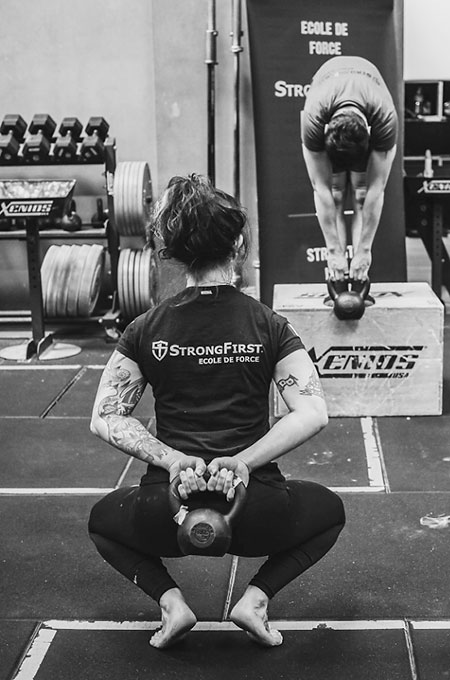
I usually strength train three times a week—a minimalistic program of two to three kettlebell, barbell, or dumbbell “big lifts,” with medium/heavy weights. I follow the same program with the same lifts for a couple of months, sometimes a couple of years, meet the goal, and then switch to something else.
Here are the examples of long-term programs I did in the last couple of years:
- Power to the People!: Barbell deadlift and bench press
- Simple & Sinister: Kettlebell goblet squat, swing, get-up
- Rite of Passage: Kettlebell clean, press, snatch
- Enter the Dumbbell: Dumbbell overhead swing, clean, press
- Imperial Program Minimum: Kettlebell swings to split (half) snatch, bent press
People following my training blog at the StrongFirst Forum or my general practice often ask, “Is this all you do? How do you maintain your other lifts? What about movement variety?”
There are many reasons to include variety days in your schedule, but I will give you three: to develop better technical proficiency, improve “in-between” strength, and boost overall resilience.
Reason #1: Keeping Your Blade Sharp
Per Bob Hoffman’s suggestion, “a greater variety of exercises are practiced—those that have been omitted on the real weight lifting days.” Variety days are your review days when you maintain the technique in other lifts and skills you are not currently practicing in your main training program, or teaching regularly.
Apart from technical review, interestingly, due to the so-called postconditioning hormesis—defined as the application of a low-level stress after a major stress event to trigger a beneficial, adaptive response that mitigates the damage from the initial event—light loads on days following heavy loads may help you recover better than if you took a whole day off. Keep the intensity low and ensure the practice does not interfere with your main training days.
I usually choose mainly “restorative” lifts with a light/moderate weight (snatch size; in my case, 24kg): prying goblet squat, get-up, windmill; plus lifts I need to work on a little bit more to dial my technique in, e.g., kettlebell jerk.
Reason #2: Developing “In-between” Strength
Marty Gallagher, a national and world champion powerlifter and coach, widely considered one of the best writers in the iron game, wrote:
Of course, you can use any type of equipment during your variety day practice—all old-time strongmen lifted all kinds of heavy weights, and I do, too—but I think that kettlebells have a special place in the arsenal precisely because they develop the in-between strength better than any other tool I know.
Arthur Saxon was world famous for his barbell bent press record of 370lb (168kg), but he still posed on the cover of his Textbook of Weightlifting with a kettlebell overhead. “Mighty Goerner” did hundreds of various lifts with all types of bells, but according to his biographer, “it would be fair to say that kettleweight training played a very large part in Goerner’s workouts.” As for modern strongmen, kettlebell lifting helped my friend and training buddy Jiří Tkadlčík to win his second world championship.
As much as I love barbells and dumbbells, the kettlebell truly is the Queen of the Iron Throne.
Reason #3: Getting Resilient
To further develop the “in-between” strength to another level, we can carefully and mindfully go beyond regular lifts and “proper” technique. That’s where StrongFirst RESILIENT comes in.
Yuri Verkhoshansky and Mel Siff recommend in their must-have book Supertraining, “injury prevention by imperfection training” and emphatically state that “all-round sports training must include the capability of coping with unexpected and sub-optimal conditions.”
The research says that ROM-restricted (and isometric) strength training produces the largest gains at the trained angle, with measurable but incomplete transfer to neighboring angles (~15°–30°). To develop resilient strength across the whole movement, you must train at several angles.
How to Get Resilient—StrongFirst RESILIENT
The training method is simple: explore positions and angles you usually avoid—deliberately and progressively—developing adaptability with lightly loaded perturbations, variability, and constraints so you can tolerate deviations when they inevitably occur.
This is the core organizing idea of StrongFirst RESILIENT: practicing “managed imperfections” and angles that standard training often skips so you can withstand unpredictable ranges, leverages, and loads in your lifting, combat arts, other collision sports, or life. The motor-control literature calls this aiming for “optimal variability”—adaptable when perturbations hit. Result: you don’t fold when the kettlebell misbehaves or if you get out of position in your MMA practice. You recover position and finish the rep (or double leg takedown) like a pro. Without getting hurt.
The StrongFirst RESILIENT curriculum systematically explores edges—progressively and safely—so you own more ranges, leverages, and positions. It includes the Resilient Get-up & Resilient Armbar series for shoulder positions you usually avoid, including interesting drills such as SOS get-up or shoulder rotator, knees over toes deep-knee bends and Hack squat progressions, Jefferson curl and Hockey deadlift to challenge default hinge rules, passive and active Hanging series, progressing all the way to “skin the cat”, gymnastic bridge work to counter the seated life, and a direct Neck series.
Exploration is dose-controlled and purposeful.
No Weak Links!
StrongFirst RESILIENT drills are not “nice-to-have extras.” They are the missing link between the strength you build in regular strength training and all the other challenges your body meets in various sports and real life. A heavy press or deadlift is predictable: perfect stance, precise groove of pull or press, controlled tempo. Life and sport rarely cooperate like that. StrongFirst RESILIENT teaches your joints, connective tissues, and nervous system to keep producing strength when the position is less than ideal—when you’re rotated, reaching, loaded asymmetrically, or coming out of a sudden “oops” moment.
Joints and muscles may not get hurt because they are weak in the strong position (they should not be—you are StrongFirst!). They may get hurt because they have never been asked to be strong a few degrees away from it. Strength is angle-specific; there is some transfer, but limited, so we take the kettlebell and own the neighboring angles. You teach the body and nervous system, “This, too, is a position you own.”
StrongFirst RESILIENT is a way to future-proof your training. As we get older, the cost of mistakes goes up. Slips, unexpected loads, getting pulled off-balance—these are not 1RM events, but you can still get injured. Regular exposure to RESILIENT drills gives you margin. That’s the whole point: stay strong longer.
Practical Example of My Current Practice
“Morning recharge”/“Health-restoring” calisthenics: Daily
- Currently, the Amosov bodyweight complex—10 exercises (forward bends, side bends, torso rotations, shoulder flexion/extension back taps, bodyweight pushups, squats, etc.), reps = matching my age. Fasted, outdoors, hot or cold weather, it does not matter. You can use many similar routines. “Mobility Complex” from your Certified Instructor’s Manual is a great start.
- Duration: About 20 minutes.
Main strength training: 3x/week (e.g., Monday, Wednesday, Friday)
- Currently, kettlebell swing to split (half) snatch & bent press, a program I am developing for StrongFirst called Imperial Program Minimum, 3x/week, medium/heavy weights.
- Duration: About 45–75 minutes.
Variety days practice: 2x/week (e.g., Tuesday and Wednesday)
- Other kettlebell skills: prying goblet squat, get-up, windmill, and some double kettlebell drills. All with a “snatch size” kettlebell—in my case, 24kg. Apart from get-up, usually about 1–3 sets of 3–5 reps.
- Other bells: An easy review of the hard style dumbbell skills from the upcoming Enter the Dumbbell program.
- StrongFirst RESILIENT: I start with a Resilient Armbar and proceed to a Resilient Get-Up. I follow with alternating selected drills from the Resilient Hanging Series and gymnastic bridge drills. Then I move to the next block, alternating Jefferson curl/Hockey deadlift and Hack squat variations. I finish with the Neck Series, spinal and neck decompression. All drills are mostly performed with a light kettlebell, e.g., 16kg.
- Duration: About 30 minutes.
Variety is the Spice of Life, but…
We at StrongFirst develop physical and mental resilience in various ways—strength training, StrongEndurance™ anti-glycolytic protocols, Second Wind breath-holds, etc.
Incorporating the “variety” days in your practice is highly recommended, but don’t get lost in all that variety, forgetting that you have to be strong first.
As Steve Maraboli said, “Life doesn’t get easier or more forgiving; we get stronger and more resilient.”
You know what to do.